
Quito, Ecuador – July 27, 2026
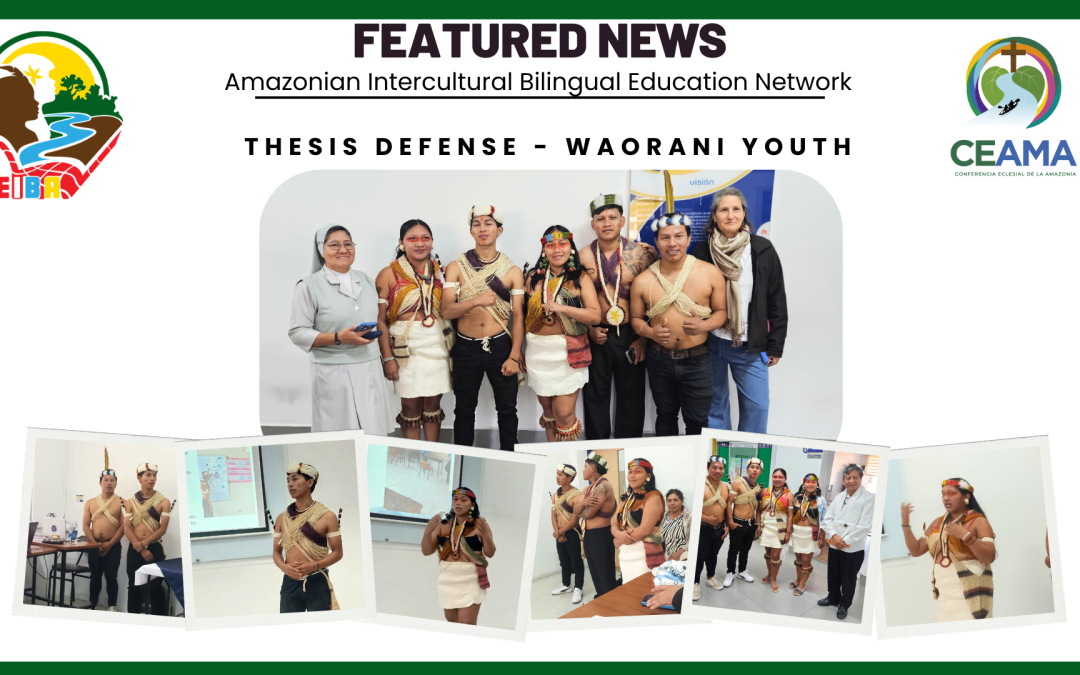
The morning of this July 27 marked a moment of profound joy and hope for the Waorani people and for REIBA. Five university students successfully defended their theses, focused on the systematization of experiences surrounding Intercultural Bilingual Education (IBE), thus culminating a training stage that represents much more than an academic achievement: it is a commitment to the life, culture, and future of their people.
A especially significant milestone of this day was that their thesis defenses were conducted in Waotededo, the native language of the Waorani people. This event constitutes a valuable recognition of the linguistic and cultural wealth of this people, and demonstrates that scientific and academic knowledge can also be expressed through indigenous languages, dignifying ancestral knowledge and strengthening the identity of those who preserve it.
Maritza Caigua, Maycol Coba, Mintoque Orengo, José Yate, and Milton Boya are the face of a new generation of teachers who have decided to respond generously to the call to serve their community through education. With dedication and perseverance, they have prepared themselves to promote, value, and strengthen Intercultural Bilingual Education, an essential tool for preserving the language, traditions, worldview, and ancestral knowledge of the Waorani people.
This achievement acquires even greater value when recognizing the challenges that many indigenous students face during their university education. For those who have Spanish as a second language, accessing undergraduate studies implies walking a path filled with linguistic, methodological, and cultural barriers that demand an extra effort. However, experiences like this demonstrate that when educational institutions, communities, organizations, and committed individuals walk together, these limitations can gradually transform into opportunities. Building a truly intercultural education implies adapting methodologies, valuing native languages, and creating conditions of greater equity so that every student can fully develop their capabilities without renouncing their identity.
Particularly valuable in this process has been the contribution of Sandra Robillard, B.A., advisor for Intercultural Bilingual Education and the Spanish as a Second Language module, who since last year has methodologically accompanied the students in strengthening their communicative skills. Her work has transcended the teaching of Spanish, also promoting that Waotededo legitimately occupies academic and professional spaces. Thanks to this accompaniment, students have strengthened their abilities to express themselves with confidence in both Spanish and their mother tongue during expositions, presentations, and other professional scenarios, proving that both languages can engage in dialogue and complement each other in a truly intercultural education.
Being a teacher in an intercultural context implies much more than teaching content. It means becoming a bridge between generations, safeguarding collective memory, and transmitting, in a pedagogical and methodological manner, the knowledge that elders have preserved for centuries. Each classroom will be a space where identity is strengthened, where the mother tongue remains alive, and where new generations learn to value their roots while developing the necessary skills to thrive in today’s world.
This path has not been traveled alone. Throughout these years, the Lauritas Sisters and the REIBA volunteers —Gabriela Valdiviezo, Isabel Laguna, Martha Chávez, Yolanda Huamancondor, and Mariela Gutiérrez— have closely accompanied this training process. With dedication, patience, and a spirit of service, they have encouraged, guided, and shared their gifts with these young people, witnessing their human, professional, and spiritual growth.