
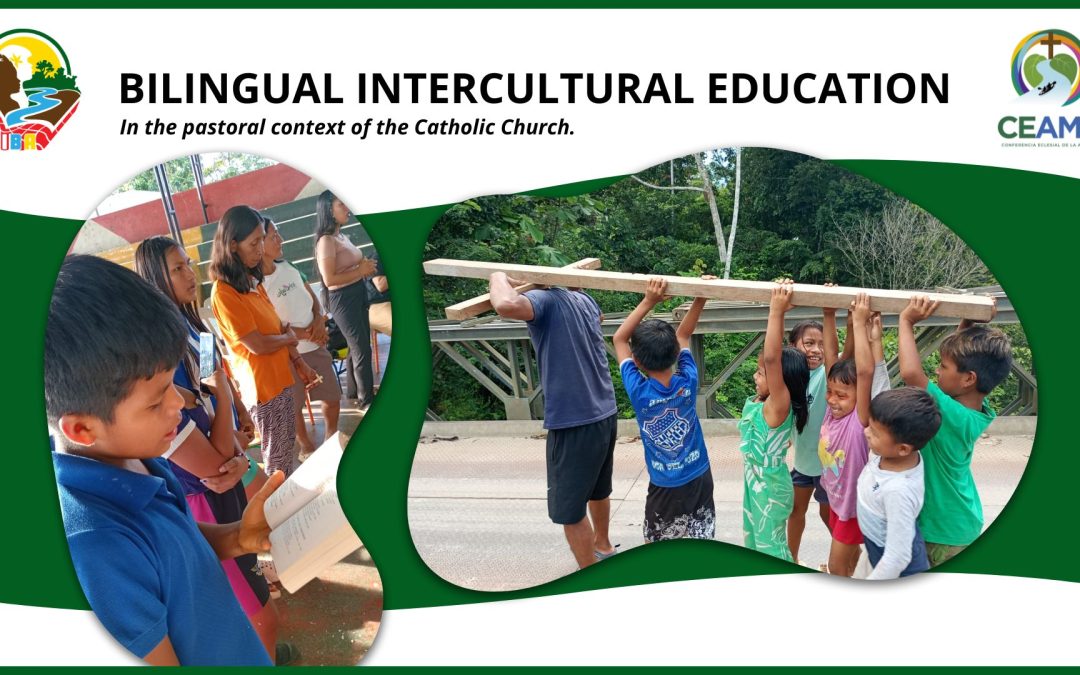
Toward an Intercultural, Community-Based Church Rooted in the People
The Catholic Church in Latin America, and especially in the Amazon region, is currently undergoing a historic moment of pastoral transformation. The social, cultural, and environmental challenges faced by indigenous and native peoples demand new forms of evangelization and community accompaniment. In this context, Intercultural Bilingual Education (IBE) emerges as a deeply necessary proposal for building a Church that is closer to the peoples, more respectful of cultures, and more faithful to the Gospel of Jesus Christ.
For a long time, evangelization was carried out using uniform pastoral models that often ignored the languages, worldviews, and organizational structures of indigenous peoples. Catechesis, liturgical celebrations, and formation processes were conducted primarily according to Western and urban frameworks, leaving little room for the cultural and spiritual diversity of the communities.
However, the path opened by the Second Vatican Council, the Latin American Episcopal Conferences, the Synod for the Amazon, and the magisterium of Pope Francis has fostered a new understanding of the Church’s mission: a synodal, intercultural, and inculturated Church. Intercultural Bilingual Education can thus become a fundamental pastoral tool for the Gospel to engage in dialogue with the cultures and languages of the peoples.
The Importance of Intercultural Bilingual Education
Intercultural Bilingual Education is an educational model designed to ensure that indigenous peoples can learn and develop through their own language and culture. It is not merely about teaching in two languages, but about building relationships based on respect and mutual learning between different cultures.
IBE recognizes that indigenous languages are bearers of memory, spirituality, and wisdom; that indigenous cultures possess valuable knowledge about life, community, and nature; that education must be grounded in the reality and experience of each people; and that cultural identity strengthens human dignity.
When this approach is applied to pastoral ministry, the need arises for a “bilingual intercultural pastoral ministry,” where evangelization does not destroy cultures, but rather engages in dialogue with them and values them as spaces where God also manifests himself.
Theological Foundations of Pastoral Ministry with EIB
Jesus was born in a specific village, spoke the language of his community, and proclaimed the Kingdom using everyday examples from rural life, fishing, and community relationships. The Incarnation teaches us that God enters human history through the cultures of peoples.
Therefore, evangelizing through BIC means:
- Proclaiming the Gospel in the mother tongue;
- Respecting cultural symbols;
- Valuing indigenous forms of spirituality and community organization;
- Recognizing that God is already present in cultures.
Pentecost and the Diversity of Languages
At Pentecost, each group heard the message in their own language. The Church was born multicultural and multilingual. This means that cultural diversity is not a threat to the faith, but a gift of the Holy Spirit.
Celebrating the liturgy in indigenous languages, training bilingual catechists, and producing intercultural pastoral materials is not simply a pedagogical strategy; it is an authentic expression of the Church’s universality.
Integral Ecology and Indigenous Peoples
Pope Francis, especially in Laudato Si’ and Querida Amazônia, has insisted that indigenous peoples have a profound relationship with creation and possess fundamental knowledge for caring for our common home.
Pastoral ministry with an EIB focus must also integrate:
- Ecological spirituality;
- Defense of territory;
- Ancestral memory;
- Care for water, forests, and rivers;
- Socio-environmental justice.
EIB in Catechesis
Catechesis in the Mother Tongue
The use of one’s own language in catechesis allows for a deeper understanding of the faith, greater participation by children, youth, and families, the strengthening of cultural identity, and the intergenerational transmission of values, knowledge, and spirituality.
However, the linguistic reality of Amazonian indigenous communities is not uniform. Therefore, catechesis with a bilingual intercultural focus can be developed from two distinct pastoral contexts:
1. Communities where children and young people have a better understanding of their native language
In these communities, the indigenous language remains the primary means of daily communication and learning. For this reason, catechesis should be conducted primarily in the native language, using stories, songs, and prayers in that language. It should also incorporate oral narratives and cultural symbols of the community, thereby strengthening the bond between faith, territory, and culture.
In these contexts, the use of the mother tongue facilitates a more intimate, understandable, and meaningful experience of the Gospel.
2. Communities where Spanish predominates, but there is a desire to revive a love for the native language
In other contexts, many children and young people primarily use Spanish due to urbanization, schooling, or language loss. However, catechesis can become an important space for revitalizing and valuing the indigenous language.
In these cases, one can:
- Work in a bilingual format;
- Incorporate words, songs, and prayers in the native language;
- Teach basic expressions related to the faith;
- Recover stories, symbols, and the cultural memory of the people;
Promote pride and affection for linguistic identity.
In this way, catechesis not only transmits religious content but also contributes to the cultural and linguistic preservation of communities.
Incorporating Cultural Symbols
Biblical parables and teachings can be related to: fishing, the river, planting, the jungle, and community life. Traditional music, local textiles and seeds, indigenous musical instruments, and oral stories and community myths can also be incorporated.
Oral Tradition and Community Learning
Many peoples transmit knowledge orally. Therefore, catechesis can include: dramatizations; storytelling; songs; discussion circles; and the participation of elders and community wise ones. The entire community thus becomes a space for learning about the faith.
Indigenous Language Education in the Eucharist and Liturgical Celebrations
Celebrations in Indigenous Languages
In contexts where the native language predominates, when readings, prayers, and songs are conducted in the indigenous language, participation increases and community identity is strengthened; in turn, the celebration becomes more intimate and meaningful.
It is also important to consider that, when communities translate liturgical texts, prayers, hymns, or catechetical materials, these processes must be carried out in dialogue and consultation with priests and/or religious sisters. This will ensure fidelity to the theological meaning of the Christian message, respect for and appreciation of the cultural expressions unique to each people, and the preservation of the musicality, oral richness, and structure inherent to the language.
this way, translation will not be merely a linguistic exercise, but also a pastoral, communal, and intercultural process that fosters an authentic inculturation of the faith.
Liturgical Inculturation
The liturgy can incorporate cultural elements compatible with the Christian faith, such as traditional musical instruments, communal dances, local symbols, and/or offerings related to the life of the people.
For example:
- River water as a sign of life;
- Seeds and fruits as symbols of abundance;
- Fire as a spiritual sign.
Inculturation does not mean changing the Gospel, but rather allowing the Gospel to take on a human face in each culture.
Contextualized Homilies
Priests and pastoral workers must understand the cultural reality of the communities in order to use relatable examples, avoid colonial language, engage with the indigenous worldview, and promote a pastoral approach of listening and accompaniment.
EIB in pastoral meetings and assemblies
Indigenous communities often participate in church meetings only symbolically. A pastoral approach with EIB requires real participation.
Translation and effective participation
Assemblies must ensure: Adequate translation, bilingual materials, spaces for horizontal dialogue, and participatory methodologies.
Pastoral gatherings may include: discussion circles, moments of contemplation, community activities, and the collective development of agreements.
Listening becomes a central element of synodality.
Pastoral formation with an EIB approach
The Church needs to form:
- Bilingual catechists;
- Pastoral translators;
- Indigenous leaders;
Ministers and religious sisters with intercultural formation.
Formation must include:
- Intercultural theology;
- Indigenous rights;
- Integral ecology;
- Conflict resolution;
- Community communication.
Challenges in implementing pastoral IBE
Many communities lack: Bibles translated into their native languages, catechetical booklets, or liturgical hymns in their native languages.
At the same time, there is a shortage of pastoral workers trained or prepared to work from an intercultural perspective.
Toward a Truly Intercultural Church
Intercultural Bilingual Education is not merely an educational methodology. It is a concrete way of building a Church that is:
- Synodal;
- Participatory;
- Intercultural;
- Committed to justice and human dignity.
It implies recognizing that God also speaks:
- in indigenous languages;
- in the memory of the elders;
- in the spirituality of the peoples;
- in the harmonious relationship with nature.
The future of the Church in the Amazon and among indigenous peoples will depend on its ability to listen, learn, and walk alongside communities.
Conclusion
The implementation of Intercultural Bilingual Education in Catholic pastoral ministry represents a historic opportunity to build a Church that is closer to the people and more faithful to the Gospel.
Catechesis, Masses, assemblies, and all pastoral activities can become spaces for intercultural dialogue where the Christian faith is lived out through the languages, symbols, and memories of the peoples.
More than translating words, pastoral IBE seeks to translate the Gospel into life, dignity, and shared hope.