
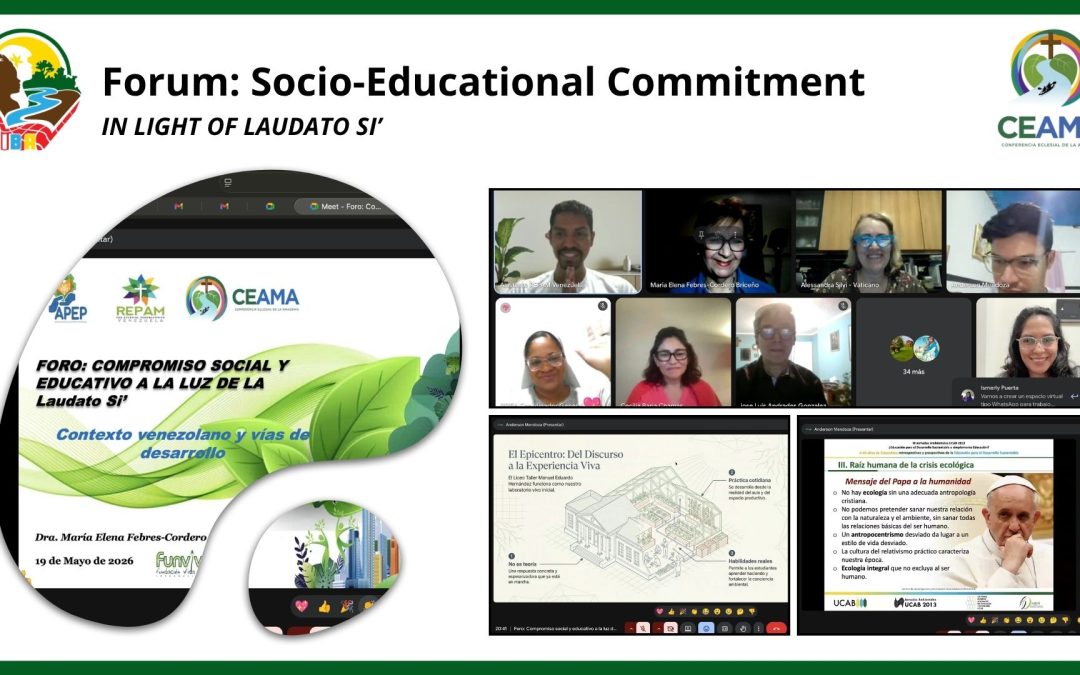
On Tuesday, May 19 of this year, Sister Marbelis Monroy (general coordinator) and Ana Gabriela Jimenez (coordinator of Intercultural Bilingual Education), representing REIBA, participated in the forum “Socio-Educational Commitment in Light of Laudato Si’,” organized by the Association for the Promotion of Popular Education (APEP).
With hope and a synodal spirit, representatives from APEP, REPAM, CEAMA, REIBA, and the Dicastery for Promoting Integral Human Development gathered to continue dreaming and building together a Church that walks alongside the people, committed to integral ecology and peace, in light of Pope Francis’ encyclical Laudato Si’.
In this space for listening, discernment, and ecclesial coordination, REIBA was invited from Venezuela to share concrete experiences that demonstrate how the principles proposed by Laudato Si’ can be brought to life in Amazonian territories, particularly through educational and community initiatives and efforts to empower indigenous peoples.
Dr. Cecilia Barja, of the Dicastery for Promoting Integral Human Development, recalled the Church’s call to listen to and accompany local churches on issues of justice, peace, human rights, migration, work, and care for creation. She also highlighted the importance of educating based on values such as care, gratitude, and shared responsibility for our Common Home.
Dr. María Elena Fébrez Cordero presented a historical and multidisciplinary perspective on *Laudato Si’*, emphasizing that integral ecology unites environmental and social concerns, and that today, more than ever, partnerships between the Church, civil society, and international organizations are necessary to address the socio-environmental crisis through participatory governance and engaged citizenship.
One of the most inspiring moments was the presentation of community initiatives led by Sr. Marbelis and Ana Gabriela, who shared participatory methodologies based on the recovery of ancestral knowledge, school gardens, ecological calendars, and training programs with Waorani youth. These initiatives demonstrate that caring for nature cannot be separated from caring for people, cultures, and human dignity.
The pilot project “Care for Our Common Home,” developed at the Manuel Eduardo Hernández High School, was also highlighted. There, students work on hydroponic systems, composting, school nurseries, and green technologies such as solar panels and environmental monitoring. These experiences show that education can become a true laboratory of hope and transformation for new generations.
The closing remarks reaffirmed the moral and spiritual urgency of continuing to strengthen ecclesial networks capable of translating *Laudato Si’* into concrete actions. Beyond isolated projects, the gathering left participants with the conviction that walking together—as a Church, communities, and organizations—is the way to care for the Amazon, defend life, and build a culture of peace based on socio-environmental justice and universal fraternity.