
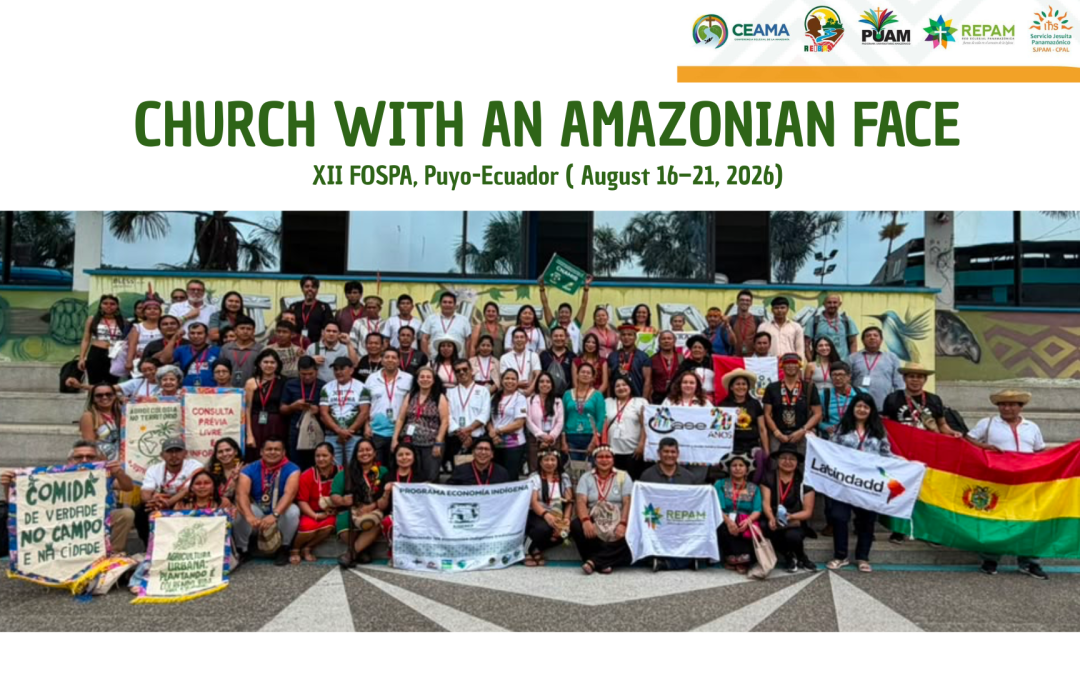
From August 16 to 21, 2026, the city of Puyuk (the native name of Puyo, Ecuador) became the epicenter of resistance and defense for the Pan-Amazon region. Within the framework of the XII Pan-Amazonian Social Forum (FOSPA), Indigenous Peoples, Afro-descendants, peasant communities, civil society, youth, and ecclesial networks from the nine countries of the basin gathered under a historical urgency: to declare the Amazon in a state of emergency to prevent reaching the «point of no return» caused by extractivism, deforestation, and the aggressive expansion of organized crime.
In this space for joint action, the Church with an Amazonian Face maintained an active presence. Institutions and networks such as the Amazonian Intercultural Bilingual Education Network (REIBA), the Ecclesial Conference of the Amazon (CEAMA), the Ecclesial Pan-Amazonian Network (REPAM), the Pan-Amazonian Jesuit Service (SJPAM), the Latin American Confederation of Religious (CLAR), and CÁRITAS joined their voices to the Mandate of the Peoples, reaffirming their commitment to the integral defense of our Common Home.
The Houses of XII FOSPA: Political Context and Thematic Axes
The forum took place in a critical geopolitical context marked by imperial wars, the rise of the far-right, authoritarianism, and disputes over strategic resources. Facing these challenges, deliberations were organized around four Thematic Houses and a transversal youth space:
Territories Free from Extractivism for an Amazon with Rights: The three-year failure to comply with the Popular Consultation on Yasuní to leave oil underground was denounced. Demands were made for a fair and popular transition, the cancellation of mining concessions, an end to mercury use, and the creation of an observatory to protect threatened territorial defenders.
Sovereignty and Self-Determination of Indigenous Peoples and Nationalities: It was ratified that indigenous peoples predate modern States, reaffirming the ancestral concept of Kawsak Sacha (Living Forest) and the strengthening of community guards. Additionally, Afro-descendant peoples demanded effective power, autonomous territoriality, and the reform of the Special Amazonian Territorial Jurisdiction Law in Ecuador.
Economies for Life and Climate Justice: Focused on building community sustainability models while categorically rejecting illegitimate foreign debt and «false solutions» such as carbon markets, debt-for-nature swaps, and biodiversity bonds, which violate prior consultation and impose loans instead of non-reimbursable financing.
Women and Diversities Resistance: Centered on highlighting women’s bodies as the primary territory of defense. The burden of care work, structural violence, the disappearance of women leaders, and the need to eradicate racism while recognizing the key role of traditional midwives and wise women were explicitly denounced.
-
Permanent Youth Camp: An intergenerational political space where young people rejected forced migration and the infiltration of psychotropic substances into communities, taking on a direct leading role in decisions concerning their territories.
Delving into House 3: Economies for Life in the Face of Dispossession
Ecclesial networks distributed their delegations among the various houses. REIBA and CEAMA, along with representatives from REPAM and SJPAM, focused their efforts on HOUSE 3: Economies for Life and Climate Justice.
There, it was reaffirmed that Economies for Life serve both as a present practice and a political horizon to prioritize the care of nature and human rights above capital:
-
Recovery of Ancestral Knowledge and Handicrafts: Initiatives were shared regarding the sustainable use of local raw materials for craft-making, generating fair income without degrading the forest.
-
Food Sovereignty and the «Semillero» Project: The protection and conservation of native and heirloom seeds against the threats of expropriation and privatization of Amazonian genetic heritage were highlighted.
Collective Proposals and Calls to Action
Pan-Amazonian Database: It was agreed to promote a regional database on seeds, ancestral knowledge, and ongoing community projects to strengthen replication methodologies across other territories.
Community Environmental Monitoring Network: A proposal was made to create a monitoring network and a Living Atlas to document socio-environmental damage and support regional strategic litigation in the Inter-American System in defense of rivers and basins.
Intercultural Education and Generational Approach: It was reaffirmed that everything begins with education. Incorporating these practices into the teaching of new generations is urgent, ensuring that women (protagonists of the care economy) and youth hold an active, binding role in decision-making.
Territorial Presence and the Struggle of the Waorani People
The Church’s work at FOSPA was concrete and deeply rooted in mission realities. During the gathering, Ana Gabriela Jimenez M., Coordinator of Intercultural Bilingual Education (EIB), represented REIBA and shared experiences with young Waorani people from REIBA Dicaro, along with outgoing volunteer Martha Chávez and Lauritas Sisters Marlene Cachipuendo and Cecilia Puentestar.
From REIBA’s central coordination, support was reaffirmed for the Waorani people’s struggle against oil companies and the contamination of their water sources. The farce of «social compensation» was exposed: the oil company recently built a water well for the community, but due to poor location, the water mixes with dirt—failing to deliver on the promise of clean water and increasing the population’s vulnerability.
A Commitment to the Future: Toward XIII FOSPA in Colombia
XII FOSPA concluded by reaffirming that communities will not wait for government willingness or formal court compliance; the peoples have decided to exercise their self-determination through co-governance. The grave humanitarian crisis caused by organized crime—drug trafficking, illegal mining, human trafficking, and smuggling—was denounced, alongside ineffective state militarization that criminalizes land defenders.
Furthermore, a special call was made for the decolonization of territories such as French Guiana, solidarity was expressed with the Palestinian people facing genocide and sexual violence in prisons, and support was extended to communities in Colombia, Peru, and Venezuela affected by recent seismic events by incorporating anticipatory risk management actions into the regional plan.
The Church with an Amazonian Face, in alliance with indigenous peoples, adopts this Puyuk 2026 Mandate so that the Amazon remains a living home. Looking ahead to the continuity of this journey, the Pan-Amazonian delegation convened for the XIII Pan-Amazonian Social Forum, to be held in Colombia.